In today’s competitive landscape, your growth engine is only as strong as its weakest link. For many CEOs, the struggle isn’t a lack of effort, but a fundamental misalignment between the two forces driving your bottom line.
Understanding the difference between marketing & sales is the first step toward scaling your revenue and dominating your industry. When these two departments operate in silos, leads fall through the cracks and your ROI stagnates.
What’s the difference between marketing & sales?
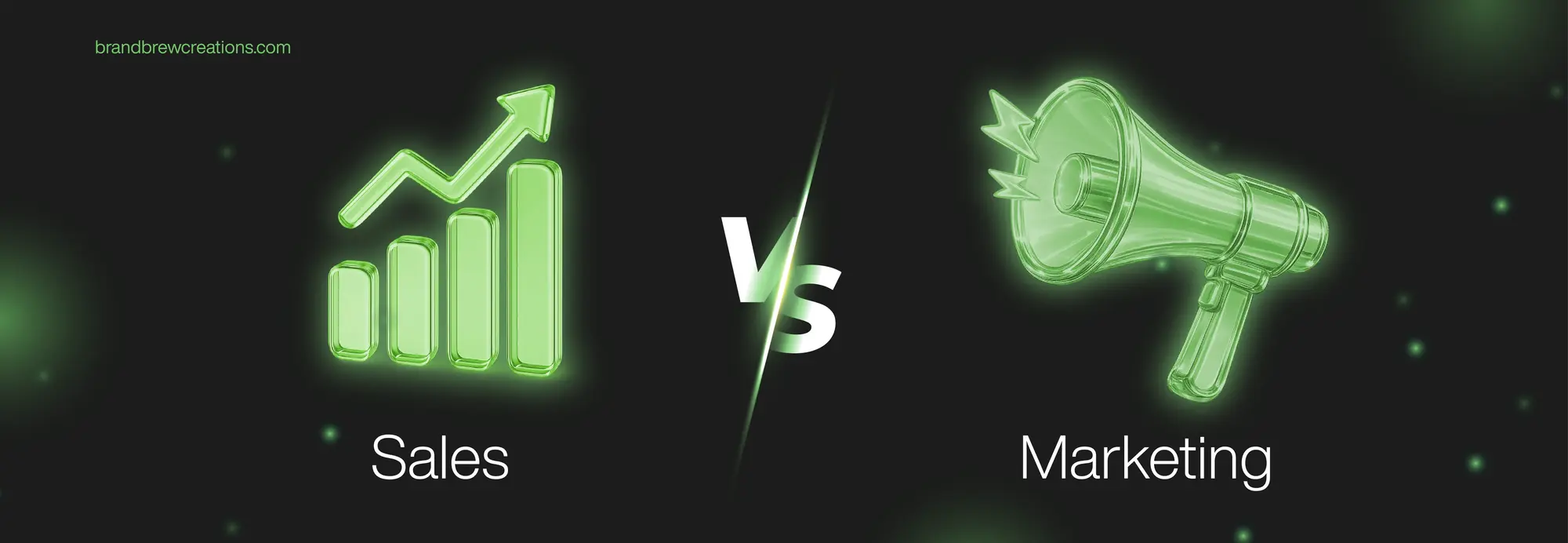
While both functions focus on the customer, they operate at different stages of the journey. Marketing is about the “many,” while sales is about the “one.” Marketing builds the foundation, and sales finishes the structure.
-Marketing
- Marketing is a comprehensive strategy for creating and delivering value to a target audience. Beyond digital channels and content, it encompasses market research, brand positioning, and product strategy to drive growth. It aims to build trust and demand by addressing customer needs throughout their entire journey, well before the point of sale.
- The primary goal is to create Marketing Qualified Leads (MQLs) by positioning your brand as the authority. It is a long-term investment in brand equity and market reach that reduces the friction for your closing team.
-Sales
- Sales is the direct, tactical process of converting interest into revenue. It involves one-on-one interactions—such as calls, demos, and negotiations—to address specific objections and finalize a purchase.
- The focus here is on short-term results and immediate targets. Sales professionals take the leads generated by marketing and leverage relationship management to ensure a high-value transaction and a signed contract.
Why do you need to know the difference between marketing & sales?
Confusing these roles leads to wasted budgets and missed opportunities. If your sales team is busy trying to build basic awareness, they aren’t closing deals; if your marketing is too “pushy,” you damage your brand reputation.
Knowing the difference between marketing & sales allows you to build a RevOps (Revenue Operations) model. Integration between these teams can increase marketing-generated growth by over 200% while significantly shortening your sales cycles.
- Optimized Budgeting: Allocate funds to marketing for reach and sales for conversion.
- Clearer KPIs: Measure marketing by lead volume and sales by revenue generated.
- Better CX: Provide a seamless transition for the buyer from “browsing” to “buying.”
How to decide which service does your business need more?
Your choice depends on your current market position and growth obstacles. If no one knows your brand exists, no amount of sales outreach will compensate for a lack of market trust.
Invest in Marketing if:
- You are launching a new product or entering a new market territory.
- Your cost-per-acquisition is too high due to a lack of brand recognition.
- You need to educate the market on a complex problem before selling a solution.
Invest in Sales if:
- You have a high volume of leads but a low conversion rate.
- You sell high-ticket, bespoke services that require intensive negotiation.
- Your business relies on a small number of high-value accounts (ABM).
You can also read about: The most effective methods to stop shopping cart abandonment
FAQ
Which is better, marketing or sales?
Neither is superior; they are interdependent components of a healthy business. Marketing opens the door to the conversation, but sales is the force that walks the customer through it to generate cash flow.A business with only marketing has “fans” but no revenue, while a business with only sales has a limited, exhausted pipeline. True ROI is found in the synergy between the two.
Which comes first, sales or marketing?
Typically, marketing comes first to lay the groundwork and build a pool of potential buyers. This “marketing-first” approach ensures your sales team spends their time talking to qualified prospects rather than cold leads.
However, in some B2B startups with anchor clients, sales may come first to secure initial capital. Once a proof of concept is established, marketing scales that success to the rest of the market.
The difference between marketing & sales is the distinction between creating a market and capturing it. To achieve sustainable growth, your organization must stop viewing them as rivals and start treating them as a unified force.
Aligning your messaging, tools, and goals across both departments will inevitably lead to higher win rates and increased customer lifetime value. Growth doesn’t happen in parallel; it happens in sync.
Is your revenue engine running at full capacity? Contact with BrandBrew’s consultants today for a comprehensive audit of your marketing and sales alignment to unlock your true growth potential.