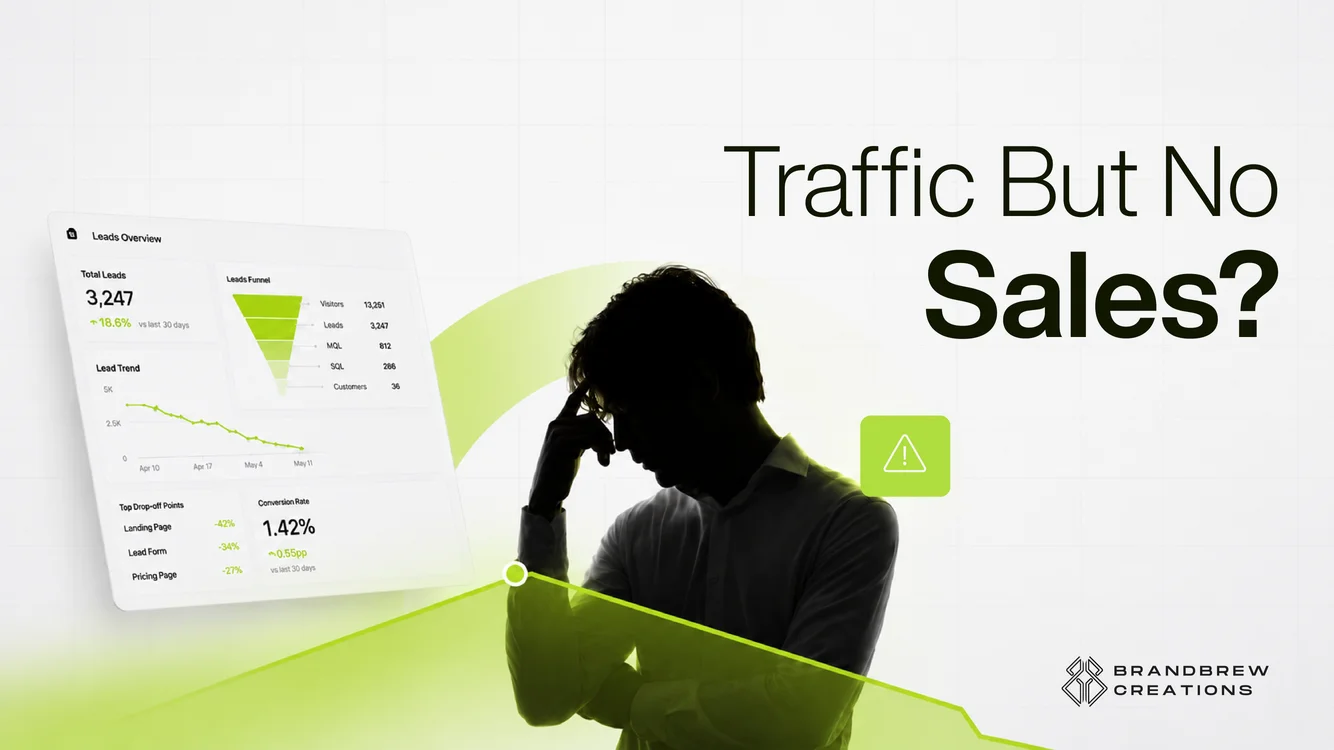
Your website’s traffic numbers look healthy, your analytics dashboard shows people visiting and browsing, but sales aren’t moving at the same pace. That situation is more frustrating than having no traffic at all, because it tells you interest exists, yet something in the middle is stopping the customer before they buy. This article breaks down the real reasons behind weak website sales, why the fix isn’t more traffic, and how to find exactly where you’re losing sales.
What does traffic without sales really signal about your business?
Traffic without sales means your website is succeeding at only one part of the customer journey — capturing attention — and failing at the part that matters most: converting that attention into an actual purchase decision. This distinction matters because most business owners assume the fix is more traffic, while the numbers are telling them the real problem sits somewhere else entirely in the journey.
The gap between attracting visitors and attracting buyers
A visitor is anyone who lands on your site, regardless of their actual intent. A buyer is a visitor with clear purchase intent who reached the right page at the right time. If your campaign is driving high traffic without precise targeting, you’ll see a high traffic number and a low conversion rate at the same time — a sign you’re attracting the wrong audience, not necessarily that your site has a technical problem.
The real reasons behind your website’s weak sales
Poor traffic quality and weak targeting
When an ad campaign targets a broad audience without precise segmentation, it brings in a high volume of cheap traffic with weak purchase intent, which shows up as a high bounce rate and short time on page.
An unclear value proposition, so visitors can’t tell what you sell or who it’s for
If a visitor needs more than a few seconds to understand exactly what you offer and who it’s for, they’ll leave the page before ever reaching a purchase decision. Clarity in the first section of the page is a decisive factor in holding a visitor’s attention.
User experience problems and site speed
A slow site or a confusing layout makes visitors lose patience before they even reach the product or service they came for. User experience isn’t a cosmetic detail — it’s a direct factor in the purchase decision.
Lack of trust, reviews, and supporting content
Customers look for trust signals before they pay: real reviews, clear product content, and a digital presence that reads as credible. Missing these signals delays the decision even when the product itself is a good fit.
A weak or invisible call to action
If a visitor isn’t sure exactly what step to take next, they’ll leave the page without acting, even if they were genuinely interested in the product.
A complicated checkout and purchase process
Every extra step in checkout reduces the odds a customer completes the purchase. Complicated or unclear steps turn real purchase intent into an abandoned page.
A Company That Fixed One Checkout Friction Point
Expedia’s website had healthy traffic, but analysts noticed customers were abandoning bookings at the payment step. Investigation revealed a single optional “Company Name” field was confusing users — many typed their bank’s name there and their bank’s address in the address field, causing card verification to fail. Removing that one field led to an immediate, measurable jump in completed bookings, adding $12 million in profit within a year. The fix wasn’t more traffic — it was one point of friction hiding in plain sight.
You may also read: Why Do Your Customers Abandon Their Cart Before Completing the Purchase?
Why the problem is conversion, not the number of visitors
Increasing traffic without fixing the conversion problem doubles your marketing cost without doubling your sales, which is one of the worst uses of a marketing budget. Even genuinely interested visitors can fall through the cracks — Baymard Institute’s cart abandonment research puts the average abandonment rate above 70%, showing that even strong purchase intent needs a frictionless experience to actually convert. The logical priority is understanding why your current visitors aren’t buying in the first place, because fixing that also improves the return on every new visitor you bring in.
You may also read: Make Your Website a Trusted Reference in Egypt: Your Guide to Implementing AEO
Why your competitor converts the same traffic you are losing
If your competitor is capturing the same type of traffic and converting more of it into sales, that’s strong evidence the problem isn’t the market or the customer’s intent — it’s specifically your site’s experience. This gap becomes clearer when you benchmark your conversion rate against industry standards, not just your own internal numbers.
You may also read: How Do You Grow Your Online Store’s Sales Sustainably?
How data analysis reveals where your sales are leaking
Analyzing the customer journey step by step, from the moment they land on your site to the moment they complete a purchase, shows you exactly where visitors stop. Baymard Institute‘s checkout usability research found the average site has more than 30 improvement opportunities in checkout alone that can meaningfully lift conversion rate, which confirms that leakage usually happens at specific, measurable points — not across the product as a whole.
Brand Brew’s perspective on turning your website traffic into customers
At Brand Brew Creations, we don’t focus on the traffic number in isolation, because on its own it’s more misleading than useful without conversion data next to it. We analyze the full customer journey on your site to pinpoint exactly where it breaks down, and connect marketing data with sales data so every decision is grounded in real numbers, not assumptions. Because our team works in sync across marketing and analysis, the fix we deliver addresses the root of the problem, not just the symptom.
u003cstrongu003eWhy is my website not making sales?u003c/strongu003e
Usually because of one or more of: imprecise targeting, an unclear value proposition, weak user experience, or missing trust signals that reassure the customer before they pay.u003cbru003e
u003cstrongu003eWhy am I getting website traffic but no leads?u003c/strongu003e
The traffic reaching your site likely doesn’t match your actual buyer intent, or the page it lands on doesn’t clearly answer what the visitor came looking for.u003cbru003e
u003cstrongu003eHow do you turn website traffic into sales?u003c/strongu003e
By analyzing the customer journey in detail, identifying exactly where visitors drop off, and improving clarity, trust, and ease of completing the purchase at that specific point.u003cbru003e
High traffic with no sales isn’t a lack of interest in your product — it’s a signal that something specific in the customer journey is stopping them before they buy. Book a 20-minute diagnostic call with Brand Brew, and we’ll show you, with data, exactly where you’re losing sales from the traffic you already have.