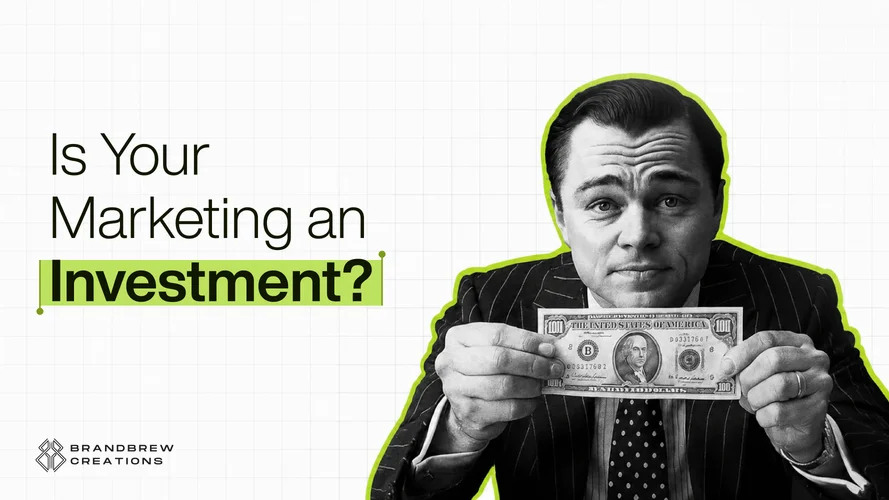
There’s a real difference between spending on marketing and investing in it, and that difference isn’t about the amount you spend — it’s about the return you get back for it. If you can’t say, in numbers, what came back from every pound you spent, you’re still just spending without knowing whether it’s actually an investment or not. This article breaks down what marketing ROI really means, and how to turn your marketing from a cost line into a measured, profitable investment.
What does ROI mean in marketing?
Return on investment, or ROI, is the metric that shows you how much you earned back for every pound spent on a given campaign or marketing activity. It’s calculated by subtracting the campaign’s cost from the revenue it generated, dividing that by the cost, and multiplying by 100 to get a clear percentage.
Why ROI separates a winning campaign from one that drains your budget
Two campaigns can have the same number of clicks or engagement, yet one returns far more revenue than the other. Without measuring ROI, you can’t tell them apart, and you might keep spending on a budget-draining campaign simply because it’s generating surface-level engagement.
The difference between marketing spend and marketing investment
Marketing spend is any amount put toward a marketing activity without a clear link to a measured return. Marketing investment is that same amount, but tied to a clear measurement of its return, and reviewable and adjustable based on actual performance. The difference isn’t the size of the amount — it’s whether a measurement system exists that turns the spend into a deliberate decision.
Why surface metrics like impressions and engagement aren’t enough to prove your campaign is working
Impressions and engagement are useful for understanding how far your message reached, but they’re not proof the campaign is generating an actual financial return. A campaign with high engagement and weak revenue looks successful on the surface, while the real numbers say the exact opposite.
A Company That Cut Spend and Raised Real Performance
In 2017, Procter & Gamble cut $200 million from its digital ad spending after discovering much of it was going to bot traffic and poorly targeted placements. Coverage of the decision reported that the company’s actual reach increased by about 10% afterward, and sales growth targets were still met. The lesson wasn’t that digital advertising doesn’t work — it’s that spending without real measurement can look like marketing while quietly returning nothing.
You may also read: Learn How Data-Driven Marketing Decisions Can Be the Decider Between a Losing and a Successful Ad Campaign
The relationship between your marketing budget and ROI
Increasing your marketing budget without improving ROI doesn’t necessarily raise your profitability — it can simply scale up the size of the loss if the campaign isn’t actually working well to begin with. The right move is improving ROI first, then increasing budget on the channels that have proven their return.
You may also read: AI Marketing & Automation in Egypt 2025
How measuring performance by the numbers gets you out of guessing
Reallocating budget toward winning campaigns
Once you know precisely which campaign delivers the highest return, the natural decision is to shift more budget toward it instead of spreading it evenly across every campaign.
Stopping losing campaigns early
Continuous ROI measurement gives you the ability to stop a losing campaign early, instead of discovering the loss only after the entire budget has already been spent.
You may also read: Marketing Agencies: The Standards of Choosing a Marketing Agency and the Signs of a Successful Agency
Signs your campaign is losing before the budget runs out
The clearest signs are high engagement paired with low conversion to actual sales, a customer acquisition cost higher than the customer’s expected value, and an inability to connect spend to clear, direct revenue.
Brand Brew’s perspective on maximizing the return on your marketing investment
At Brand Brew Creations, every campaign we propose comes with a clear method for measuring its return before we even begin. HubSpot’s guide to calculating marketing ROI shows that measuring ROI requires connecting the number of leads, the lead-to-customer conversion rate, and average sale price — and that’s exactly the approach we apply. McKinsey’s research on data-driven marketing decisions confirms that companies making decisions based on data improve marketing ROI by 15 to 20 percent. Because our departments work in sync, the decisions we deliver ensure every pound in your budget is directed toward the highest possible return.
What is a good marketing ROI?
It varies by industry and channel, but the key isn’t a fixed benchmark — it’s whether your ROI is consistently measured, understood, and improving over time.
What is an example of ROI in marketing?
Spending 10,000 on a campaign that generates 30,000 in revenue produces a 200% ROI, calculated as (30,000 − 10,000) ÷ 10,000 × 100.
What does a 20% ROI mean?
It means you earned back 20% more than what you spent — for every pound invested, you got back 1.20, a modest but positive return that’s usually worth optimizing further.
What is the marketing ROI formula?
The basic formula is: (Revenue Generated − Investment Cost) ÷ Investment Cost × 100 = ROI%.
If you can’t say, in numbers, what came back from your marketing budget, you’re still spending — not investing. Book a 20-minute call with Brand Brew, and we’ll show you how to measure and improve the return on your marketing investment.